



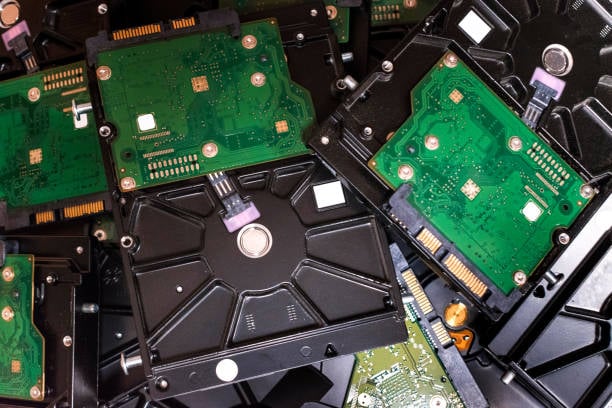
Modern enterprise infrastructure teams regularly decommission high-density server racks, refresh storage arrays, and retire endpoint devices. When hard drives and solid-state drives leave active production, basic file deletions and operating system formatting fail to protect proprietary business records.
Implementing verified secure hard disk disposal guarantees that sensitive intellectual property, employee records, and confidential customer databases remain permanently inaccessible. At E-XPIRE, we provide certified IT asset disposition and media destruction solutions that safeguard corporate balance sheets, ensure regulatory compliance, and deliver auditable peace of mind.
The Hidden Vulnerabilities of Improper Storage Media Retirement
When hard drives, solid-state drives, and enterprise backup tapes uncouple from active production systems, their organizational threat profile changes from operational uptime to long-term data liability.
Forensic Vulnerabilities and Residual Data Risks
Standard operating system formatting commands only erase the index tables pointing to file locations on a drive. The actual binary data remains completely intact across the storage sectors. Threat actors and unauthorized third parties routinely purchase surplus enterprise hardware from online auctions and secondary brokers, using basic recovery software to reconstruct corporate active directories, customer records, and trade secrets.
Federal enforcement bodies continually highlight the severe consequences of unmanaged media disposal. According to enforcement reports published by the Federal Trade Commission (FTC), identity theft, consumer fraud, and data security violations generate billions of dollars in reported losses annually, with regulatory agencies taking aggressive legal action against organizations that fail to maintain reasonable physical disposal safeguards for sensitive consumer records. Implementing certified secure hard disk disposal prevents these regulatory actions and eliminates exposure risks.
The Regulatory Realities for Modern Enterprises
Enterprise IT departments must navigate a complex landscape of legal mandates requiring provable data sanitization:
- Healthcare Organizations: Regulated under the Health Insurance Portability and Accountability Act (HIPAA), requiring documented, permanent destruction of electronic protected health information (ePHI).
- Financial Institutions: Governed by the Gramm-Leach-Bliley Act (GLBA) and Sarbanes-Oxley (SOX), which mandate strict safeguard rules and auditable physical disposal trails for customer financial records.
- Corporate and Public Entities: Subject to state data protection legislation and the Fair and Accurate Credit Transactions Act (FACTA) Disposal Rule, mandating reasonable measures to protect against unauthorized access to consumer information during hardware retirement.
Evaluating Sanitization Methods: Logical Erasure vs. Physical Destruction
Enterprise IT teams must choose between software-based logical sanitization and physical mechanical destruction. Each approach addresses distinct operational and compliance requirements.
| Sanitization Method | Operational Mechanism | Hardware Impact | Ideal Application |
| NIST 800-88 Logical Clear | Overwrites all addressable storage sectors with verified pseudorandom binary patterns | Drive remains fully functional for reuse | Modern, healthy enterprise drives designated for secondary market remarketing |
| Cryptographic Erase (CE) | Sanitizes self-encrypting drives (SEDs) by purging the internal hardware encryption keys | Hardware remains reusable; near-instant execution | High-capacity encrypted enterprise SSDs and NVMe storage modules |
| Magnetic Degaussing | Subjects magnetic platters to powerful magnetic fields, disrupting bit alignment | Permanently disables drive motor and firmware | Defective mechanical hard disk drives (HDDs) and magnetic backup tapes |
| Mechanical Industrial Shredding | High-torque industrial blades physically tear drives into small particle fragments | Complete physical destruction; zero recovery possible | Failed drives, end-of-life media, SSDs, and high-security compliance mandates |
While logical sanitization preserves hardware for secondary commercial resale, utilizing an accredited hard disk disposal service centered around mechanical shredding delivers absolute certainty for media that has reached the end of its functional life.
Establishing an Unbroken Chain of Custody
Data security failures frequently occur outside corporate server rooms during transport. When thousands of hard drives leave data center racks, maintaining continuous custody documentation prevents asset shrinkage and regulatory non-compliance.
Research and supply chain directives from the Cybersecurity and Infrastructure Security Agency (CISA) emphasize that physical security controls form the baseline of total enterprise protection, warning that unmonitored supply chain transfers and physical custody disruptions create direct access vectors for hardware tampering and data theft.
Securing media transit requires strict logistical procedures:
- Serialized Manifest Tracking: Technicians scan and record every drive serial number before unmounting equipment, establishing an auditable baseline manifest.
- Tamper-Evident Enclosures: Media is loaded into heavy-duty, rolling security containers secured with numbered, tamper-evident seals.
- Monitored Fleet Transport: When moving media off-site, organizations rely on specialized logistics and transportation featuring climate control, active GPS route tracking, and dual-driver custody teams.
- Dual-Signoff Transfer Receipts: Authorized logistics supervisors and client IT managers inspect seal numbers and countersign manifests at every physical handoff.
Balancing Environmental Sustainability with Certified Data Destruction
Managing storage retirement responsibly involves both absolute digital security and strict environmental compliance. Discarding electronics into general waste streams violates corporate environmental, social, and governance (ESG) commitments and creates hazardous material contamination.
Mechanical storage drives and enterprise solid-state drives contain hazardous heavy metals alongside valuable raw commodities, including aluminum, steel, copper, and rare-earth neodymium magnets.
Once industrial shredding blades reduce storage media into small scrap particles, the material is not sent to a landfill. A certified ITAD partner routes the shredded residue through specialized material recovery systems:
- Magnetic drums pull out ferrous steel drive covers and casings.
- Eddy current separators extract non-ferrous aluminum platter scrap.
- Density separators sort circuit board fragments, gold pins, and industrial plastics.
These separated commodities travel directly to certified domestic smelting facilities to be re-melted into clean manufacturing supply chains. Integrating secure asset & hard drive recycling ensures that total data destruction and corporate zero-landfill goals work together seamlessly.
The E-XPIRE Advantage: Certified Enterprise Media Destruction
Safeguarding sensitive enterprise information requires an accredited partner equipped with commercial shredding capabilities, certified security protocols, and verifiable reporting. At E-XPIRE, we eliminate compliance risks through our comprehensive ITAD infrastructure.
Our complete framework for enterprise data protection delivers total operational peace of mind:
- Certified NIST 800-88 Compliance: We execute media sanitization and physical destruction adhering strictly to NIST Special Publication 800-88 Revision 1 guidelines, issuing formal, audit-ready Certificates of Data Destruction.
- On-Site and Off-Site Destruction Capabilities: We deploy mobile shredding vehicles directly to your facility for witnessed, dockside destruction or provide secure, GPS-tracked transportation to our centralized processing facility.
- Serialized Chain of Custody: Every drive receives an individual intake barcode scan, ensuring continuous tracking from your server racks to the shredder blade.
- Zero-Landfill Environmental Commitment: All shredded metallic remnants and electronic circuit scrap re-enter clean manufacturing supply chains through certified circular recycling partnerships.
Our structured workflows protect data, eliminate administrative overhead, and ensure that your corporate data destruction meets the most rigorous regulatory standards.
Operational Verification Checklist for IT and Compliance Managers
To ensure an efficient and disruption-free media disposal project, review this operational verification checklist before moving equipment:
| Operational Phase | Critical Verification Item | Standard of Excellence |
| Inventory Audit | Cross-reference drive serial numbers against internal CMDB | 100% reconciliation of physical drives to digital records |
| Physical Isolation | Segregate failed drives and storage arrays into locked bins | Dual-key authorization required for storage bin access |
| Transit Security | Verify numbered tamper-evident seals and driver credentials | Serialized seals match paperwork before vehicle departs |
| Compliance Documentation | Obtain an itemized, formal Certificate of Data Destruction | Includes drive serial numbers, method, timestamp, and technician signature |
Secure Your Enterprise Storage Media Today
Decommissioned hard drives, magnetic tapes, and enterprise solid-state drives should never gather dust in unmonitored IT storage closets or enter general disposal streams. Choosing an accredited, commercial provider for secure hard disk disposal protects your brand reputation, eliminates regulatory non-compliance fines, and ensures that sensitive data is permanently destroyed.
Protect your enterprise with verified, certified media destruction. Contact E-XPIRE today to speak with our data protection specialists, schedule an on-site mobile shredding truck, and secure your upcoming storage retirement project.
Frequently Asked Questions
1. What makes physical hard disk shredding more secure than disk wiping?
Disk wiping relies on software to overwrite sectors, which can fail if drives have bad sectors, firmware corruptions, or mechanical defects that prevent access to hidden storage blocks. Physical shredding uses industrial carbon-steel blades to fracture drive platters and silicon chips into small fragments, making data reconstruction physically impossible.
2. What specific details must appear on a Certificate of Data Destruction?
A legally defensible Certificate of Data Destruction must record the project date, facility location, specific destruction methodology (such as mechanical shredding or NIST 800-88 multi-pass wipe), technician signature, and an itemized list of every serialized drive processed.
3. Can enterprise solid-state drives (SSDs) be processed with standard hard drive shredders?
Standard rotary hard drive shredders cut material into strips designed for large magnetic platters, which can allow tiny flash memory chips on SSDs to slip through unbroken. High-security disposal requires specialized SSD cross-cut shredders that pulverize circuit boards and fracture individual silicon dies down to small particle sizes.
4. How does an unbroken chain of custody protect against regulatory fines?
An unbroken chain of custody provides timestamped, serialized documentation showing that data-bearing drives were tracked, secured, and handled exclusively by authorized personnel from de-installation to destruction. This audit trail proves to regulatory bodies that patient records, consumer data, or financial files were never left exposed to unauthorized parties.
5. Can our organization witness the physical destruction process on site?
Yes. Professional ITAD providers operate mobile shredding vehicles equipped with high-torque shredders and video monitors. Your internal IT and security personnel can observe the intake scan, watch drives enter the shredder hopper, and inspect the shredded material directly at your facility loading dock.