



Secure Hard Disk Disposal: Best Practices for Enterprise Data Security
Modern enterprise infrastructure teams regularly decommission high-density server racks, refresh storage arrays, and retire endpoint devices. When hard drives and solid-state drives leave active production, basic file deletions and operating system formatting fail to protect proprietary business records.
Implementing verified secure hard disk disposal guarantees that sensitive intellectual property, employee records, and confidential customer databases remain permanently inaccessible. At E-XPIRE, we provide certified IT asset disposition and media destruction solutions that safeguard corporate balance sheets, ensure regulatory compliance, and deliver auditable peace of mind.
The Hidden Vulnerabilities of Improper Storage Media Retirement
When hard drives, solid-state drives, and enterprise backup tapes uncouple from active production systems, their organizational threat profile changes from operational uptime to long-term data liability.
Forensic Vulnerabilities and Residual Data Risks
Standard operating system formatting commands only erase the index tables pointing to file locations on a drive. The actual binary data remains completely intact across the storage sectors. Threat actors and unauthorized third parties routinely purchase surplus enterprise hardware from online auctions and secondary brokers, using basic recovery software to reconstruct corporate active directories, customer records, and trade secrets.
Federal enforcement bodies continually highlight the severe consequences of unmanaged media disposal. According to enforcement reports published by the Federal Trade Commission (FTC), identity theft, consumer fraud, and data security violations generate billions of dollars in reported losses annually, with regulatory agencies taking aggressive legal action against organizations that fail to maintain reasonable physical disposal safeguards for sensitive consumer records. Implementing certified secure hard disk disposal prevents these regulatory actions and eliminates exposure risks.
The Regulatory Realities for Modern Enterprises
Enterprise IT departments must navigate a complex landscape of legal mandates requiring provable data sanitization:
- Healthcare Organizations: Regulated under the Health Insurance Portability and Accountability Act (HIPAA), requiring documented, permanent destruction of electronic protected health information (ePHI).
- Financial Institutions: Governed by the Gramm-Leach-Bliley Act (GLBA) and Sarbanes-Oxley (SOX), which mandate strict safeguard rules and auditable physical disposal trails for customer financial records.
- Corporate and Public Entities: Subject to state data protection legislation and the Fair and Accurate Credit Transactions Act (FACTA) Disposal Rule, mandating reasonable measures to protect against unauthorized access to consumer information during hardware retirement.
Evaluating Sanitization Methods: Logical Erasure vs. Physical Destruction
Enterprise IT teams must choose between software-based logical sanitization and physical mechanical destruction. Each approach addresses distinct operational and compliance requirements.
| Sanitization Method | Operational Mechanism | Hardware Impact | Ideal Application |
| NIST 800-88 Logical Clear | Overwrites all addressable storage sectors with verified pseudorandom binary patterns | Drive remains fully functional for reuse | Modern, healthy enterprise drives designated for secondary market remarketing |
| Cryptographic Erase (CE) | Sanitizes self-encrypting drives (SEDs) by purging the internal hardware encryption keys | Hardware remains reusable; near-instant execution | High-capacity encrypted enterprise SSDs and NVMe storage modules |
| Magnetic Degaussing | Subjects magnetic platters to powerful magnetic fields, disrupting bit alignment | Permanently disables drive motor and firmware | Defective mechanical hard disk drives (HDDs) and magnetic backup tapes |
| Mechanical Industrial Shredding | High-torque industrial blades physically tear drives into small particle fragments | Complete physical destruction; zero recovery possible | Failed drives, end-of-life media, SSDs, and high-security compliance mandates |
While logical sanitization preserves hardware for secondary commercial resale, utilizing an accredited hard disk disposal service centered around mechanical shredding delivers absolute certainty for media that has reached the end of its functional life.
Establishing an Unbroken Chain of Custody
Data security failures frequently occur outside corporate server rooms during transport. When thousands of hard drives leave data center racks, maintaining continuous custody documentation prevents asset shrinkage and regulatory non-compliance.
Research and supply chain directives from the Cybersecurity and Infrastructure Security Agency (CISA) emphasize that physical security controls form the baseline of total enterprise protection, warning that unmonitored supply chain transfers and physical custody disruptions create direct access vectors for hardware tampering and data theft.
Securing media transit requires strict logistical procedures:
- Serialized Manifest Tracking: Technicians scan and record every drive serial number before unmounting equipment, establishing an auditable baseline manifest.
- Tamper-Evident Enclosures: Media is loaded into heavy-duty, rolling security containers secured with numbered, tamper-evident seals.
- Monitored Fleet Transport: When moving media off-site, organizations rely on specialized logistics and transportation featuring climate control, active GPS route tracking, and dual-driver custody teams.
- Dual-Signoff Transfer Receipts: Authorized logistics supervisors and client IT managers inspect seal numbers and countersign manifests at every physical handoff.
Balancing Environmental Sustainability with Certified Data Destruction
Managing storage retirement responsibly involves both absolute digital security and strict environmental compliance. Discarding electronics into general waste streams violates corporate environmental, social, and governance (ESG) commitments and creates hazardous material contamination.
Mechanical storage drives and enterprise solid-state drives contain hazardous heavy metals alongside valuable raw commodities, including aluminum, steel, copper, and rare-earth neodymium magnets.
Once industrial shredding blades reduce storage media into small scrap particles, the material is not sent to a landfill. A certified ITAD partner routes the shredded residue through specialized material recovery systems:
- Magnetic drums pull out ferrous steel drive covers and casings.
- Eddy current separators extract non-ferrous aluminum platter scrap.
- Density separators sort circuit board fragments, gold pins, and industrial plastics.
These separated commodities travel directly to certified domestic smelting facilities to be re-melted into clean manufacturing supply chains. Integrating secure asset & hard drive recycling ensures that total data destruction and corporate zero-landfill goals work together seamlessly.
The E-XPIRE Advantage: Certified Enterprise Media Destruction
Safeguarding sensitive enterprise information requires an accredited partner equipped with commercial shredding capabilities, certified security protocols, and verifiable reporting. At E-XPIRE, we eliminate compliance risks through our comprehensive ITAD infrastructure.
Our complete framework for enterprise data protection delivers total operational peace of mind:
- Certified NIST 800-88 Compliance: We execute media sanitization and physical destruction adhering strictly to NIST Special Publication 800-88 Revision 1 guidelines, issuing formal, audit-ready Certificates of Data Destruction.
- On-Site and Off-Site Destruction Capabilities: We deploy mobile shredding vehicles directly to your facility for witnessed, dockside destruction or provide secure, GPS-tracked transportation to our centralized processing facility.
- Serialized Chain of Custody: Every drive receives an individual intake barcode scan, ensuring continuous tracking from your server racks to the shredder blade.
- Zero-Landfill Environmental Commitment: All shredded metallic remnants and electronic circuit scrap re-enter clean manufacturing supply chains through certified circular recycling partnerships.
Our structured workflows protect data, eliminate administrative overhead, and ensure that your corporate data destruction meets the most rigorous regulatory standards.
Operational Verification Checklist for IT and Compliance Managers
To ensure an efficient and disruption-free media disposal project, review this operational verification checklist before moving equipment:
| Operational Phase | Critical Verification Item | Standard of Excellence |
| Inventory Audit | Cross-reference drive serial numbers against internal CMDB | 100% reconciliation of physical drives to digital records |
| Physical Isolation | Segregate failed drives and storage arrays into locked bins | Dual-key authorization required for storage bin access |
| Transit Security | Verify numbered tamper-evident seals and driver credentials | Serialized seals match paperwork before vehicle departs |
| Compliance Documentation | Obtain an itemized, formal Certificate of Data Destruction | Includes drive serial numbers, method, timestamp, and technician signature |
Secure Your Enterprise Storage Media Today
Decommissioned hard drives, magnetic tapes, and enterprise solid-state drives should never gather dust in unmonitored IT storage closets or enter general disposal streams. Choosing an accredited, commercial provider for secure hard disk disposal protects your brand reputation, eliminates regulatory non-compliance fines, and ensures that sensitive data is permanently destroyed.
Protect your enterprise with verified, certified media destruction. Contact E-XPIRE today to speak with our data protection specialists, schedule an on-site mobile shredding truck, and secure your upcoming storage retirement project.
Frequently Asked Questions
1. What makes physical hard disk shredding more secure than disk wiping?
Disk wiping relies on software to overwrite sectors, which can fail if drives have bad sectors, firmware corruptions, or mechanical defects that prevent access to hidden storage blocks. Physical shredding uses industrial carbon-steel blades to fracture drive platters and silicon chips into small fragments, making data reconstruction physically impossible.
2. What specific details must appear on a Certificate of Data Destruction?
A legally defensible Certificate of Data Destruction must record the project date, facility location, specific destruction methodology (such as mechanical shredding or NIST 800-88 multi-pass wipe), technician signature, and an itemized list of every serialized drive processed.
3. Can enterprise solid-state drives (SSDs) be processed with standard hard drive shredders?
Standard rotary hard drive shredders cut material into strips designed for large magnetic platters, which can allow tiny flash memory chips on SSDs to slip through unbroken. High-security disposal requires specialized SSD cross-cut shredders that pulverize circuit boards and fracture individual silicon dies down to small particle sizes.
4. How does an unbroken chain of custody protect against regulatory fines?
An unbroken chain of custody provides timestamped, serialized documentation showing that data-bearing drives were tracked, secured, and handled exclusively by authorized personnel from de-installation to destruction. This audit trail proves to regulatory bodies that patient records, consumer data, or financial files were never left exposed to unauthorized parties.
5. Can our organization witness the physical destruction process on site?
Yes. Professional ITAD providers operate mobile shredding vehicles equipped with high-torque shredders and video monitors. Your internal IT and security personnel can observe the intake scan, watch drives enter the shredder hopper, and inspect the shredded material directly at your facility loading dock.

When Should Businesses Use a Hard Disk Disposal Service Instead of Device Storage?
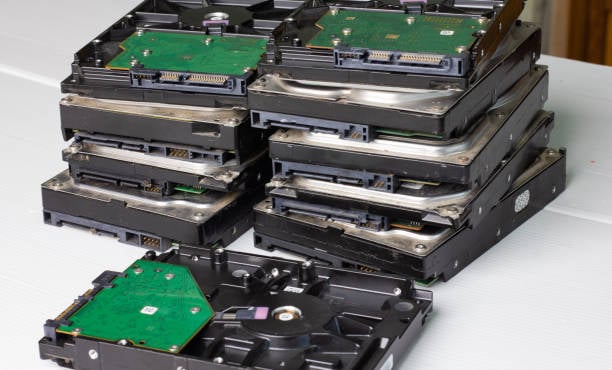
Enterprise technology refresh cycles, data center server migrations, and routine endpoint upgrades leave organizations with hundreds or thousands of retired storage drives. For data center operators, IT managers, and enterprise procurement teams, handling these decommissioned drives creates a challenging operational dilemma. Many organizations choose to place obsolete magnetic hard disk drives (HDDs) and solid-state drives (SSDs) into secure storage closets, believing that keeping devices on premises avoids data breach exposure.
In reality, stockpiling old storage media creates significant compliance liabilities, physical security vulnerabilities, and hidden facility expenses. When you work with a certified hard disk disposal service such as E-XPIRE, we eliminate these threats by providing verified physical shredding, automated data sanitization, and full serialized custody tracking directly at your facility or processing center.
Understanding the exact inflection points where stockpiling media becomes a major corporate liability helps IT directors make proactive, secure, and cost-effective disposal decisions.
The Hidden Risks and Realities of Corporate Device Stockpiling
Many organizations view physical storage as a safe default option. When an employee leaves the company or a server rack receives an upgrade, IT staff frequently place retired drives in a locked cabinet or warehouse shelf. While the immediate intention is to retain records or address destruction later, device stockpiling quickly turns into an uncontrolled risk center.
Physical storage rooms create severe organizational vulnerabilities over time:
- Internal Theft and Undetected Loss: Storage closets often lack continuous video surveillance or dual-custody access logs, allowing dishonest employees or outside contractors to remove loose drives unnoticed.
- Shadow Inventory Growth: As hardware piles up, serial numbers drop off active configuration management databases (CMDB), making it impossible to confirm whether your company still possesses specific drives.
- Gradual Hardware Degradation: Prolonged exposure to humidity and temperature fluctuations in unmonitored storage areas can degrade magnetic drive platters and flash memory controllers, complicating future forensic audits.
According to research and investigative audit findings from the U.S. Government Accountability Office (GAO), weaknesses in physical security at surplus IT storage locations and delays in data sanitization significantly heighten the risk of data breaches, with unmonitored stockpiles frequently resulting in missing hardware and lost inventory.
Hiring a professional provider to execute business hard drive disposal prevents these liabilities by establishing immediate custody handoffs and certified destruction logs.
Regulatory Compliance Deadlines and the Legal Duty to Destroy Data
Holding onto obsolete drives indefinitely is not just an inventory problem; it also violates statutory data privacy mandates. Under laws such as HIPAA, the Gramm-Leach-Bliley Act (GLBA), FACTA, and the European Union General Data Protection Regulation (GDPR), businesses maintain a strict legal duty to safeguard consumer information and destroy sensitive records once retention periods expire.
Federal regulators actively penalize organizations that retain personal consumer data without a legitimate business purpose. The Federal Trade Commission (FTC) Business Guidance on Data Security emphasizes that companies must not hold sensitive personal information longer than needed and must execute secure disposal procedures once records reach their end-of-life status.
When evaluating your stored drives, consider the following regulatory trigger points that require prompt disposal:
- Expiration of Statutory Record Retention: Once corporate tax, accounting, or medical record retention windows close, you must destroy the underlying physical storage media to prevent secondary legal discovery risks.
- Customer Right-to-Be-Forgotten Requests: Data privacy laws require organizations to purge consumer information across all physical and backup media upon formal request.
- Audit Notification Requirements: External compliance audits require verifiable, cryptographically validated Certificates of Destruction rather than simple self-attestation statements.
High-Risk Scenarios Demanding Immediate Hard Disk Disposal
While routine equipment upgrades justify regular disposal cycles, specific operational triggers demand immediate third-party intervention instead of temporary physical storage.
Critical Operational Triggers for Professional Disposal:
1. Corporate Relocations and Office Consolidations
2. Data Center Decommissioning and Cloud Migrations
3. Endpoint Fleet Refreshes (Laptops and Workstations)
4. Mergers, Acquisitions, and Corporate Divestitures
5. Storage Media Hardware Failures and Sector Corruption
Data Center Decommissioning and Server Upgrades
Data center environments concentrate vast amounts of proprietary data on high-density storage arrays. When decommissioning enterprise server racks, leaving high-capacity SAS hard drives or NVMe SSDs in storage creates massive corporate vulnerability. Utilizing a specialized hard disk disposal service ensures that drives undergo immediate on-site degaussing or high-capacity mechanical shredding before servers leave the facility dock.
Mergers, Acquisitions, and Divestitures
Corporate restructuring events require clear separation of intellectual property and digital liability. Storing legacy systems creates confusion over data ownership and creates regulatory risk for the acquiring firm. Professional disposal permanently purges legacy storage assets and establishes clean, audited asset boundaries between business units.
Hardware Failures and Bad Disk Sectors
When mechanical platters seize or solid-state memory controllers fail, software-level data wiping utilities cannot access the drive to overwrite information. Leaving failed drives in a cabinet does not eliminate the latent data residing on intact silicon chips. Physical mechanical destruction is the only compliant method to render corrupted storage media permanently unreadable.
How E-XPIRE Delivers Certified Hard Drive Disposal Solutions
Managing storage media destruction across complex enterprise footprints requires an accredited partner with proven industrial capabilities. At E-XPIRE, our team provides certified secure media disposal and complete lifecycle management designed to remove operational friction from your internal IT staff.
Whether you operate corporate offices, financial headquarters, or regional branch hubs, our specialists at E-XPIRE in New York and across our nationwide network enforce strict security standards for every project:
- Point-of-Collection Serialized Auditing: We scan drive barcodes and serial numbers on-site at your facility, validating your manifest before loading equipment into secure transport bins.
- On-Site and Plant-Based Mechanical Shredding: We operate high-torque industrial media shredders that reduce mechanical hard drive platters and SSD flash memory chips into fragments measuring under 0.75 inches (19 mm) or smaller.
- Serialized Destruction Documentation: We issue cryptographically signed Certificates of Destruction detailing drive serial numbers, timestamps, method of destruction, and supervising technician credentials.
- Responsible Commodity Recovery: We route shredded metal and circuit boards directly into our certified electronics recycling solutions to guarantee zero-landfill disposal.
We take full responsibility for the chain of custody, ensuring that your organization remains audit-ready and legally protected.
Mechanical Hard Drives vs. SSDs: Why Storage Types Change Disposal Methods
Treating all storage media identically creates dangerous security blind spots. Mechanical hard disk drives (HDDs) store data magnetically on spinning platters, while solid-state drives (SSDs) store information electronically across NAND flash memory cells.
The differences between these two storage architectures fundamentally alter how IT teams must execute IT asset retirement:
Mechanical Hard Disk Drives (HDDs)
- Sanitization Method: Multi-pass software overwriting (NIST Clear) or high-field magnetic degaussing (NIST Purge).
- Physical Destruction: Industrial shredding that punctures and bends magnetic platters.
- Disposal Risk Factor: Degaussing effectively scrambles magnetic domains on HDDs, making subsequent data extraction impossible even if platters remain intact.
Solid-State Drives (SSDs and NVMe Media)
- Sanitization Method: Cryptographic firmware erasure commands or block-level purge protocols.
- Physical Destruction: Specialized micro-shredding that disintegrates individual NAND flash memory chips.
- Disposal Risk Factor: Magnetic degaussers have zero effect on flash memory. If an enterprise applies degaussing to SSDs without physical micro-shredding, all stored data remains completely readable.
When you hire a specialized hard disk disposal service, certified technicians inspect media types and apply the appropriate mechanical or logical destruction protocols for each specific hardware category.
Financial Comparison: The True Cost of Storage vs. Professional Disposal
Many procurement managers assume that keeping retired hardware in a storage closet is free. However, calculating the total cost of ownership reveals that passive storage is far more expensive than active destruction.
Evaluating the Cost Dimensions
- Real Estate and Facility Overhead: Dedicating expensive square footage in corporate office buildings or raised-floor data center environments to obsolete hardware wastes valuable operational space.
- Staff Time and Inventory Tracking: IT personnel must continually recount, log, and inspect stored devices during annual inventory reconciliations.
- Catastrophic Breach Liabilities: The financial fallout from a single misplaced hard drive containing confidential customer records far exceeds the nominal cost of hiring a certified destruction provider.
- Uncaptured Material Value: Delaying disposal prevents your organization from reclaiming scrap commodity value from non-working media or remarketing usable chassis components.
Review our comprehensive suite of IT disposition services to see how our structured workflows minimize overhead costs while maximizing security and value recovery.
The Chain of Custody Standard: From Facility Floor to Final Shred
When selecting a vendor for media destruction, the physical transfer process represents the highest risk link in the security chain. A professional hard disk disposal service guarantees that no equipment travels unmonitored.
Our team enforces a five-step chain of custody protocol:
- Serialized Pre-Audit: Technicians scan every individual drive serial number against your internal IT inventory records.
- Tamper-Evident Locking Bins: Scanned media transfers directly into heavy-gauge, serialized steel security containers locked in your presence.
- GPS-Monitored Freight: Transport vehicles utilize real-time satellite tracking, secondary bulkhead locks, and background-checked drivers.
- Monitored Facility Destruction: Media undergoes immediate processing inside access-controlled destruction bays equipped with continuous closed-circuit video recording.
- Final Certificate Delivery: We upload authenticated destruction logs and signed certificates to your compliance portal immediately after project completion.
Enterprise Hard Drive Disposal Assessment Checklist
Use this operational checklist to evaluate whether your stored media requires immediate professional destruction:
- Have your stored drives remained in unmonitored storage for longer than 30 business days?
- Do the drives contain sensitive employee data, financial records, or customer information?
- Are you preparing for an upcoming internal, financial, or regulatory compliance audit?
- Do your storage media assets include failed solid-state drives that cannot undergo software wiping?
- Does your facility lack dedicated, CCTV-monitored, badged-access storage rooms?
- Can your current records verify the physical location of every decommissioned storage serial number?
If you answered yes to any of these questions, your organization should transition from passive device storage to certified professional disposal immediately.
Conclusion: Eliminate Storage Risks with E-XPIRE
Holding obsolete hard drives in storage closets creates a false sense of security while increasing your company's exposure to theft, regulatory penalties, and data leaks. Proactive, certified hard drive disposal eliminates corporate liabilities, ensures defensible compliance, and frees up valuable enterprise resources.
At E-XPIRE, we deliver the specialized shredding technology, certified chain of custody, and auditable reporting your organization needs to protect its sensitive data. To schedule an on-site shredding project or discuss media destruction solutions for your enterprise, contact our team today to speak with an ITAD specialist.
Frequently Asked Questions (FAQs)
What is a professional hard disk disposal service?
A professional hard disk disposal service provides certified, auditable destruction of magnetic hard drives, solid-state drives, and backup media. These services include on-site serialized scanning, industrial shredding or degaussing, responsible metal recycling, and the issuance of formal Certificates of Destruction.
Why is storing old hard drives in an office closet dangerous?
Storing retired drives creates significant risks of internal theft, misplacement, and data leaks. Without continuous video surveillance and serialized inventory tracking, loose drives can disappear without detection, exposing your company to severe data privacy penalties.
Can degaussing be used on solid-state drives (SSDs)?
No. Degaussing relies on powerful magnetic fields to disrupt data domains on magnetic media such as mechanical hard drives and magnetic tapes. Solid-state drives store data electronically across NAND flash memory chips and are completely unaffected by magnetic degaussing. SSDs require physical micro-shredding or cryptographic purge sanitization.
What information must appear on a Certificate of Destruction?
A valid Certificate of Destruction must include individual drive serial numbers, the exact date and timestamp of destruction, the physical facility address, the destruction method applied (such as physical shredding to a specific millimeter size), the name of the operating technician, and a formal statement of regulatory compliance.
How does E-XPIRE handle the shredded materials after destruction?
After mechanical shredding, E-XPIRE separates the destroyed fragments into base commodities, including aluminum, steel, copper, and shredded circuit board materials. These materials route directly to certified downstream recyclers for smelting and circular manufacturing, ensuring a strict zero-landfill outcome.